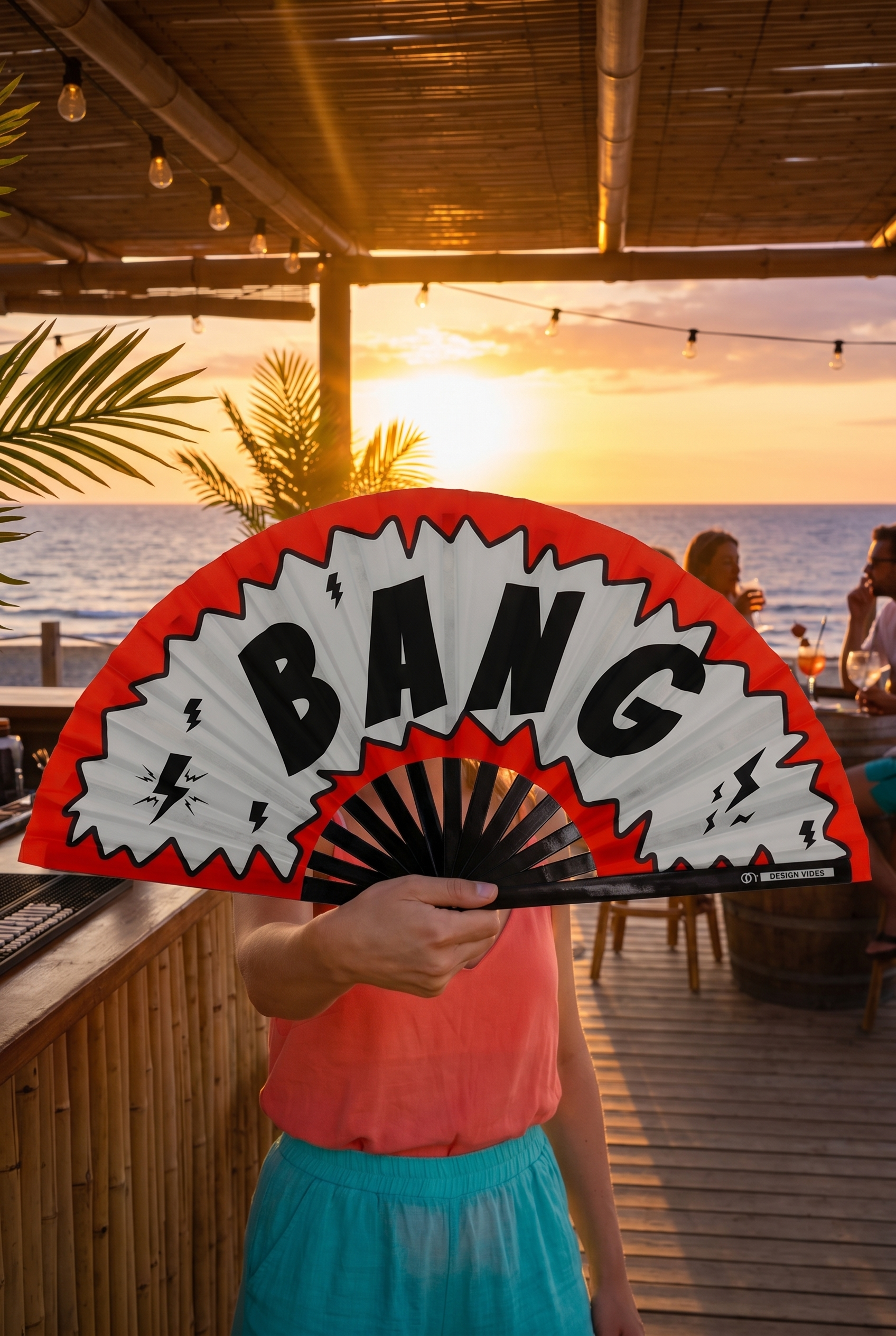
A one-day festival in late August; the sun is high in the sky, and the crowd is making its way through the dust between two stages. And then a word catches your eye, you can read it from twenty meters away: BANG. Not a banner, not a merch stand, but a comic-themed fan with a wide span. Pop Art fans are the boldest design statement in our collection, and that’s saying something when the competition consists of holographic effects and glitter. In this guide, you’ll learn what defines the Pop Art aesthetic, why comic-style graphics work so incredibly well from a distance, and how to style this bold look without letting it wear you instead of you wearing it.
Pop Art Fans: Why BANG, ZAP, and POW Are Never Quiet
In the 1960s, Pop Art brought the visual language of advertising and comic books into the museum: bold outlines, bright primary colors, halftone dots, and onomatopoeia in all caps. The principle behind it is simple, and that’s exactly why it’s so powerful. One image, one message, zero room for interpretation. BANG is BANG. ZAP is ZAP. It takes your eye less than a second to understand what’s happening.
It is precisely this directness that makes this aesthetic a perfect match for a hand fan. When in use, a fan is constantly in motion, it is opened, waved, and closed. Intricate, interlocking motifs tend to blur in the process. Comic art, on the other hand, remains legible because it consists of just a few distinct elements. Every time the fan is opened, it’s like a panel from a comic book, opened just for that moment. And with the signature “Clack”, the loud snap when it opens, the whole thing even gets its own sound effect. Onomatopoeia you can touch.
Comic fans are legible from 20 meters away: the logic of graphic design
Why can you make out a comic-style fan across the floor, while a finely detailed pattern becomes nothing more than noise from as far as five meters away? The answer lies in contrast. Comic designs rely on extreme shifts in brightness and color: black against yellow, red against white, thick outlines around every shape. Your brain loves these edges; it processes them faster than any intermediate stage.
Then there’s the size. When unfolded, this piece has a 64 cm span, that’s more display area than most posters in your first shared apartment had. At this width, capital letters and grid dots don’t look lost; instead, they’re perfectly proportioned. A single word spanning 64 cm is simply more legible than any print on a T-shirt that wrinkles when you’re dancing. The fabric is tear-resistant and stretched taut over the bamboo frame, so the graphic stays flat like a canvas instead of wrinkling like fabric.
The result: Your design stands out where visibility matters most, in the crowd, on the way between stages, in line at the water fountain. Anyone looking for you will find you. And even if they don’t know you, they’ll still remember the BANG fan.
Day Festival and Campground: Your Stage for the Comic Look
Comic fans have two natural habitats. The first is the daytime festival with sunshine, dust, and daylight sets. This is where the bright primary colors really shine, because unlike neon designs, they don’t need black light or lasers to glow. Daylight is more than enough. The brighter the sun, the sharper the contrast, and the better your fan looks.
The second living space is the campground. Between the pavilion, the folding chair, and the morning beer, the comic book fan is both an entertainer and a tool: It creates a breeze when the tent turns into a sauna at nine in the morning, and it provides the punchline for every group photo. A ZAP in the picture, and no one can keep a straight face anymore. Most small talk happens at the campground, and a fan with comic art is a conversation starter that saves you from having to come up with the first line. If you want to know what else to pack, check out our festival packing list for all the gear you’ll need for the weekend.
Styling: Bold graphics with simple outfits
The most important styling rule for Pop Art fans is also the simplest: The fan is the star of the show; your outfit is the stage. Comic-style graphics don’t mix well with wild patterns on your clothes. What works are calm, solid basics that give the design room to shine.
- All-Black: A black shirt, black shorts, and the comic book fan is the only splash of color. Maximum contrast, maximum impact.
- White and cream: Light-colored basics make the primary colors in the fan shine as if they were printed on paper. The clean, gallery-style look.
- Denim: A denim jacket or shorts are neutral enough in color not to clash with red, yellow, and cyan, and they add texture on their own.
- A Color Echo: If you like, pick out exactly one color from the color fan in your outfit, for example, yellow socks to match the yellow BANG. One color, not three.
What you should avoid: pairing a comic-print fan with an outfit that already features prints, batik, and neon. That’s like two loudspeakers competing against each other, and neither one wins. If your look is already as colorful as it gets, a solid-colored, understated design or a statement fan with clean lettering is a better choice, one that channels the energy rather than doubling it.
The “feel-good” factor: why comic-style graphics appeal to people
There are designs that make an impression, and designs that set the mood. Holographic fans are the former: hypnotic, elegant, a bit sci-fi. Comic-style fans are the latter. No one can look at a big “POW” and keep a straight face. The aesthetic is so clearly linked to fun, exaggeration, and a touch of whimsy that it acts as a social signal: This isn’t a place to post, it’s a place to party.
You’ll notice this in your everyday life at the venue. With a comic book fan, people will approach you more often, smile at you more often, and ask to take a photo with you more often. It lowers people’s inhibitions because it signals that you don’t take yourself too seriously. And that’s exactly what Front Row is all about: not wanting to be the coolest person in the crowd, but the one people want to stand next to.
A comic book fan isn’t just an accessory. It’s the speech bubble your outfit has always needed.
Who the Comic Category Is For
Let’s be honest: it’s not for everyone, and that’s a good thing. If you’d rather shimmer mystically on the dance floor, go for Holo. If you want to glow under black light at night, go for Neon. The comic fan is for people who are just as loud during the day as they are at night. It’s for the person in the group who organizes the photos, starts the choreography, and stands in the front row during the daytime set.
It’s also the perfect choice for anyone buying their first Festival Fan who can’t decide between the different design styles. The comic design works anywhere: day festivals, city festivals, birthdays, Carnival, or pre-partying on the balcony. The design doesn’t need a special occasion or special lighting, it creates its own stage. Plus, it’s built to last: the bamboo frame and tear-resistant fabric will hold up through a third season, and with the “Buy 5, Pay for 4” bulk deal, you can outfit your whole crew with fans right away. Imagine five people fanning out in unison: BANG, ZAP, BOOM, POW, and a loud, five-fold “Clack” to go with it. That’s not just a performance, it’s a cliffhanger.
If you’re in the mood for bold graphics right now, check out the comic-themed fans in this category or browse through all the design themes in the entire shop. Each fan has a 64 cm span, a satisfying “Clack,” and is shipped from Hamburg, ready to ship within 24 hours. Your next fan is already waiting for you. Find your next folding hand fan on our homepage, or see every design at once among our hand fans for festivals.