
Thirty-four degrees, not a breath of wind, and in front of the stage stand a few thousand people, all wanting the same thing: air. There are two options for a breeze on your face: the rechargeable fan from the gadget shelf and the hand fan, which people have been using for centuries. We sell fans, we have to be transparent about that. But that’s exactly why we’re doing a proper fan-versus-hand-fan comparison: criterion by criterion, honestly evaluated, including the situations where the fan actually comes out on top.
Fan Comparison: Seven Criteria, an Honest Assessment
To ensure a fair comparison, both will be tested in the same categories: battery life and availability, airflow, noise, weight, durability, appearance, and cost over time. Then comes the ultimate test: use in an environment where dust, crowds, and twelve hours of continuous operation all come together.
To put things in perspective: We’re talking about situations where staying cool really matters. Twelve hours at a festival in the blazing sun, the dense crowd in front of the stage, the line with no shade, the sweltering tent in the morning, and a night out at a club with no fresh air. A cooling device that only works well on your desk won’t help you out there. That’s why we evaluate each criterion from the perspective that matters to you: on the go, on the move, right in the thick of things.
Battery and Availability
The fan provides a breeze at the push of a button, but only as long as the battery holds out. On the high setting, it runs out of power after just a few hours, and then it ends up competing for your power bank’s charge with the one device that’s more important: your cell phone. The fan simply doesn’t have this problem. It runs as long as your wrist keeps moving, and that’s surprisingly easy to train yourself to do.
Airflow
This is where it gets interesting. The fan generates a constant, narrow stream of air that feels pleasant close to your face. The fan works in waves: with a 64-centimeter span, a single flap moves a volume of air that the small rotor can’t match. It cools your face, neck, and upper body in a single motion, and if your friends are standing nearby, you’ll just fan them along with yourself. For hours of continuous breeze while standing, the fan takes the lead; for quick, intense cooling, the fan wins out.
Noise
A fan hums. Constantly. You don’t notice it in the crowd, but you certainly do in the tent at midnight or during a quiet set. The fan is practically silent when it’s fanning, and the only sound it makes is intentional: the signature “Clack” when it opens up. One is operational noise; the other is a statement.
Weight and Packed Dimensions
Both are lightweight, but the fan is flat. When folded up, it fits right into a fanny pack or your waistband, no charging cable, no spare battery, no need to plan for overnight charging. The fan, on the other hand, comes with its own logistics: one more cable, one more device, one more thing that needs power in the evening.
Shelf Life
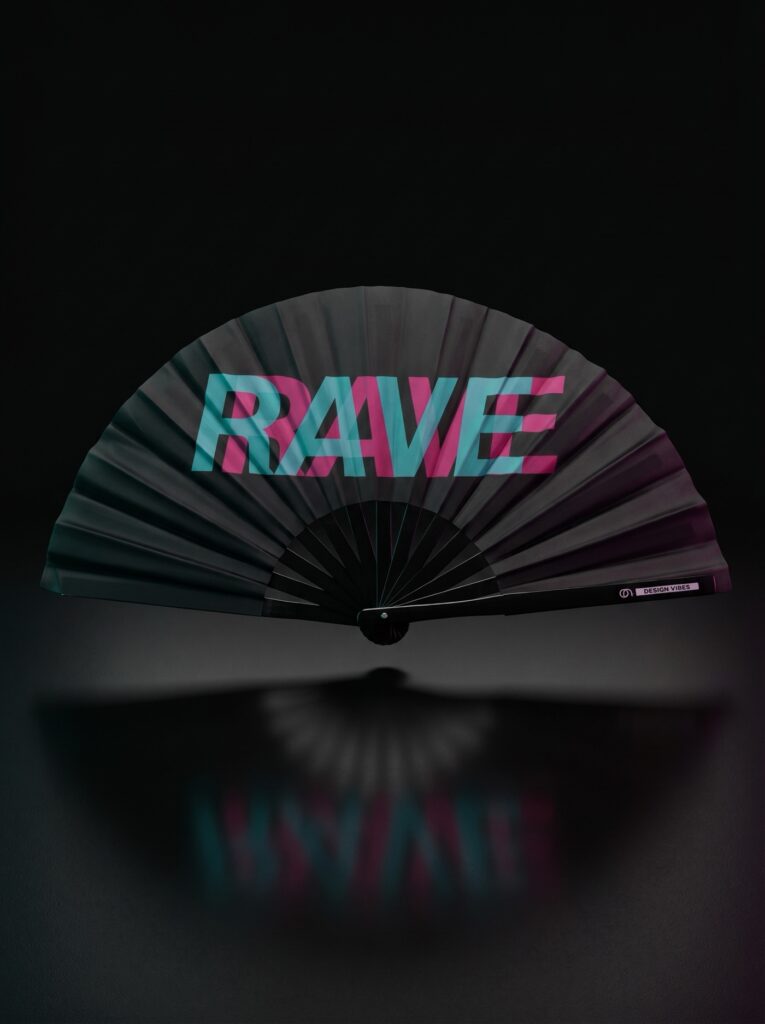
Festivals mean dust, sand, spilled drinks, and at least one fall to the ground. Electronics don’t take kindly to any of this: dust in the rotor, moisture in the housing, and worn-out battery cells after a season. A fan with a bamboo frame and tear-resistant fabric is built specifically for this environment: no battery that ages, no mechanics that get clogged, nothing that takes a rain shower personally.
Look
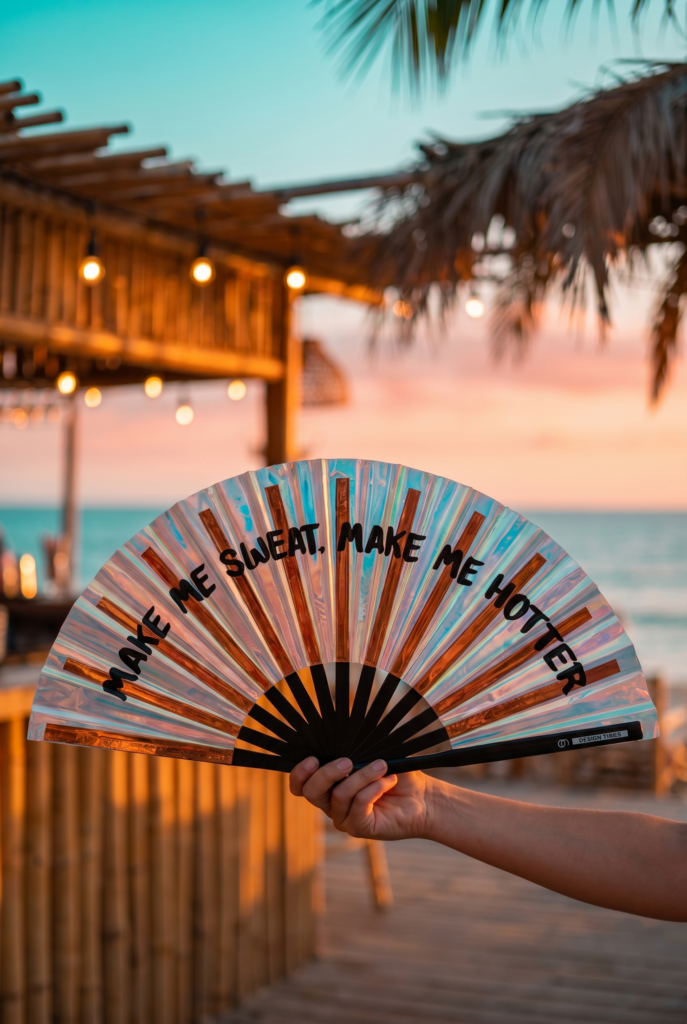
Let’s be honest: The fan looks like a tool. Practical, yes, but no one takes pictures of it. A holographic fan that changes color under lasers, on the other hand, is part of your outfit and often the reason for the photo. One keeps you cool. The other keeps you cool and tells the world who you are.
Costs Over Time
Ignoring price tags: What matters isn’t how much a device costs, but how often you have to replace it. Experience shows that cheap rechargeable fans are disposable items at festivals, they last one season at best. A well-made fan will last you through many summers, as long as you don’t use it as a seat cushion. Durability is the most stress-free way to save money.
Rechargeable Fan at the Festival: Practical Problems
On paper, the fan seems solid, but in the field, it falls short. Dust is its natural enemy: whatever blows through the crowd all day eventually ends up in the rotor. In a dense crowd, the spinning device gets close to strangers’ faces and long hair, making it a tricky situation. And then there’s the dependency: if the battery dies at the six-hour mark of a twelve-hour event, you’re left holding a piece of dead plastic for the rest of the night.
The fan doesn’t have these kinds of problems. It never runs out of battery, its rotor never gets clogged, and no hair ever gets tangled up in it. Its only risk is that you’ll leave it lying around, and even that can be prevented with a simple habit: After you fan yourself, put it right back in your fanny pack.
Then there’s the weather. A summer thunderstorm is part of every festival, and while a fan simply dries off afterward, with a fan, you start worrying about the electronics. The gadget also comes up short when it comes to sharing: You’ll pass a fan around without a second thought, but you’re much less likely to pass along a sweaty plastic case with a spinning fan. At a festival, staying cool is a group effort, and for that, the gadget without a button is simply better designed.
Where the Fan Really Shines
Let’s be fair: There are situations where a fan is the better choice. At your desk, where there’s a power outlet within reach and you need to keep both hands on the keyboard. On the stroller, securely fastened and out of reach of little hands, providing a steady breeze for the afternoon walk. Generally speaking, anywhere you’re not moving, no one hears the hum, and continuous operation is more important than style. In short: The fan wins when you’re stationary.
Even for the office, where, in the height of summer, you find yourself caught between the screen and the window, this small fan is a perfectly viable solution. It runs for hours on low speed, requires no effort at all, and its appearance doesn’t stand out among the file folders. So our point isn’t that the fan is a bad product. Our point is that it was built for a different kind of life than the one lived at festivals.
Where the fan shines: Anywhere you’re on the move
Once you’re out and about, the picture changes completely. Crowds, lines, festival tents in the morning, club nights, midsummer protests, city trips, the beach: The fan doesn’t need a power outlet, weighs almost nothing, withstands dust and rain, and looks great to boot. And it can do something no fan will ever learn to do: communicate. The Clack to the beat, fanning it open as a performance, the design as a statement.
From glitter to statement slogans, it’s a fashion accessory that just happens to be the best cooling tool in its weight class. It’s precisely this dual role that makes all the difference: a gadget solves a problem, a fan solves a problem, and tells your story along the way.
And then there’s the social aspect: a fan is a conversation starter. People comment on its design, share the breeze, and respond to its Clack. When traveling, it fits in any side pocket; at the beach, it replaces the tired waving of a magazine; and at a summer wedding, it saves entire rows of chairs. In short: It’s the only cooling tool you’ll eventually slip into your pocket out of habit, just like your keys and cell phone.
“A fan creates a breeze. A fan creates a breeze, sound, and makes a statement, and you’re its battery.”
The Bottom Line at a Glance
- Battery and Availability: Fans. No charging, no dying at the six-hour mark.
- Wind conditions: mixed. A steady, focused breeze versus a powerful wave, depending on the situation.
- Noise: Fan. No constant hum, the Clack sound only happens when you want it to.
- Weight and pack size: Fan, tight. Flat beats compact plus cables.
- Durability: Fan, by a clear margin. Bamboo and tear-resistant fabric versus sensitive electronics.
- Look: Fans, no question about it.
- Stationary use: Electric fan. Its home is on a desk and in a stroller.
- Festival-readiness: Fans. Dust, crowds, and twelve hours of operation decide the showdown.
At the end of the day, it’s not a matter of religion: If you want, pack both and use each tool where it shines. But if there’s only one spot left in your fanny pack, take the one that’s never empty, survives anything, and looks good in photos. In the shop, you’ll find designs ranging from holographic to comic-style, ready to ship from Hamburg within 24 hours. Your wrist takes care of the rest. Browse every design in our hand fans collection, or start on our homepage to find the right hand fan for your next festival.