It’s Sunday afternoon, the sun is directly overhead, and ten thousand people are surging toward the main stage right in front of you. Not a breath of wind, not a gap, not a speck of shade. At this very moment, it’s decided whether your fan is just a pretty accessory or your best weapon against the heat. And that decision comes down to the fan’s surface area. The span of your fan determines how much air you move with each stroke, and 64 cm isn’t just a random number—it’s the point where a noticeable breeze and comfortable handling come together. Here, we’ll explain why that’s the case, why bigger doesn’t automatically mean better, and how you can use the right technique to get maximum airflow from minimal movement.
Area times speed: The simple physics behind airflow
You don’t have to be an engineer to understand what makes a fan cool. The basic rule is very simple: how much air you move depends on two things—the surface area of your fan and the speed at which you wave it through the air. A large surface area multiplied by fast movement equals a lot of airflow. A small surface area multiplied by a slow, tentative wave equals: almost nothing.
The best part is that the surface area is the part you buy once and then never have to touch again. A faned Festival Fan with a 64-centimeter span moves about twice as much air with every movement as a handy pocket fan measuring a good 30 centimeters. That means: To get the same cooling sensation, you have to fan twice as fast and for twice as long with the smaller model. After twenty minutes in the crowd, you won’t notice this difference in your head—you’ll feel it in your wrist. Size works for you, so you don’t have to work as hard.
There’s also a second effect that many people underestimate: evaporation. Moving air wicks away the thin layer of sweat on your skin more quickly, and it’s precisely this evaporation that cools you down. A wide stream of air reaches not only your face but also your neck, décolletage, and nape all at once. A narrow fan blows away the sweat from your forehead, at best, while the rest of your body continues to feel hot.
Why 64 cm Is the Sweet Spot
If a large surface area is good, why not just go for a huge fan with a one-meter span? Because fanning is a movement you repeat for hours on end, and at some point, the advantage turns into a disadvantage. A fan that’s too big becomes heavy, unwieldy, and sluggish. You can’t move it through the air fast enough anymore; the motion turns into a shoulder workout, and in a tight crowd, you end up ramming the ribs of the person next to you with the fan’s ribs on every swing. A large surface area is useless if you can’t move it quickly anymore, because then speed is missing from the equation.
At the other end of the spectrum is the classic pocket fan. It fits in any fanny pack, looks dainty, and is perfectly fine while waiting for the train. But it just doesn’t cut it at a festival. The surface area is too small to really make a difference in sweltering heat, and you’ll end up waving it around until you’re tired without getting properly cooled off.
64 cm is right in the middle. Large enough that a single, relaxed movement creates a breeze you can feel immediately on your skin. Small and light enough that you can wave it with a flick of the wrist, carry it with you for hours, and won’t bump into anyone in a crowd. The tear-resistant bamboo frame keeps the fan surface taut and stable, so the air doesn’t escape to the sides but flows forward toward you. This balance of surface area, weight, and maneuverability is why the 64 cm span isn’t just a marketing gimmick—it’s the practical solution for a long, hot day.
A good fan isn’t measured by how big it is, but by how little effort it takes to stay cool.
The Wrist Technique: Lots of Power, Little Fatigue
The most common mistake is to fan with your whole arm. It looks like a lot of work, but it takes a tremendous amount of energy and you won’t last even half an hour. The secret of people who look fresh all day lies in the wrist. Keep your upper arm still against your body and let only your wrist tilt back and forth. Short, relaxed movements—no straining. The large surface area does the actual work; you just provide the momentum.
Here’s how to get the most out of your large hand fan with minimal effort:
- Keep your elbows relaxed at your sides; don’t let your arms swing. The movement comes from your wrist.
- Tilt the fan slightly upward so that the airflow sweeps across your face and neck from below, rather than blowing into empty space.
- Rhythm over speed. A steady, calm back-and-forth cools you down more effectively than frantic sprints, after which you’ll need a break.
- Switch hands before your hand gets tired. If you train both sides, you can fan twice as long without getting a cramp.
- When there’s a little space, swing a bit more vigorously; when the crowd is dense, revert to small, controlled movements.
When you hear that rich, signature “Clack” as you fan out the wings—that loud snap when they open—you know the wing is fully extended and ready for action. That “Clack” isn’t just a sound; it’s confirmation that the entire span is functioning properly.
Where 64 cm Makes All the Difference
Theory is all well and good, but it’s in real-world situations that the span really proves its worth. There are three situations in which you’ll be grateful for every centimeter of surface area.
Right in the middle of the crowd in front of the main stage
Crowded together, no draft, body heat coming from all sides. Here, a large fan is the only source of fresh air that you can control yourself. Its wide surface creates a noticeable breeze for you—and often for the person right next to you—while a pocket fan barely makes a difference in this heat.
In the line at the entrance
Standing in the blazing sun, no movement, no distractions. This is exactly the kind of situation where small fans show their limitations, because you have to keep fanning yourself endlessly. At 64 cm, a gentle flick of the wrist is all it takes, and you stay cool while others stand there sweating and staring at their watches.
In the morning in the heated tent
As soon as the sun beats down on the tent roof, the inside turns into a sauna, and opening the tent often just lets in even warmer air. A large fan circulates enough air to dispel the stagnant heat above your sleeping pad and make the start of your day bearable before you even step outside.
Size also means visibility
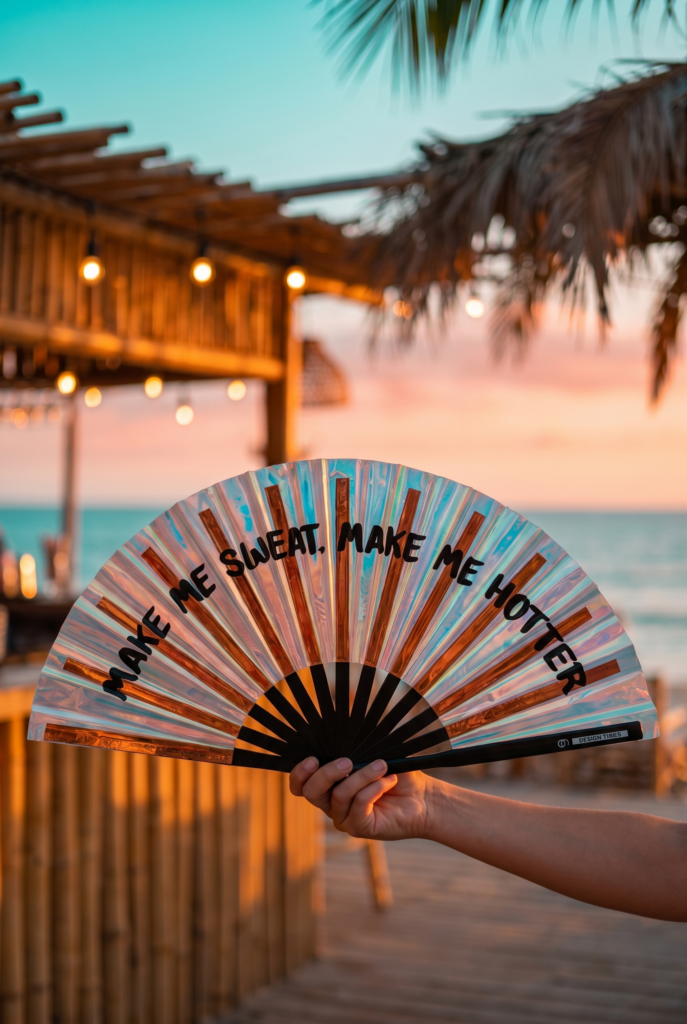
The fan doesn’t just cool you down—it gets noticed. When spread out to 64 cm, it creates a surface that stands out even from a distance, and that’s exactly what makes the fan a statement piece. An open fan held above the crowd is a signal—a Front Row attitude that you hold aloft. Your crew can spot each other more easily in the crowd when everyone raises the same fan high, and when the beat drops, individual fans come together to form a wave that’s visible from the stage.
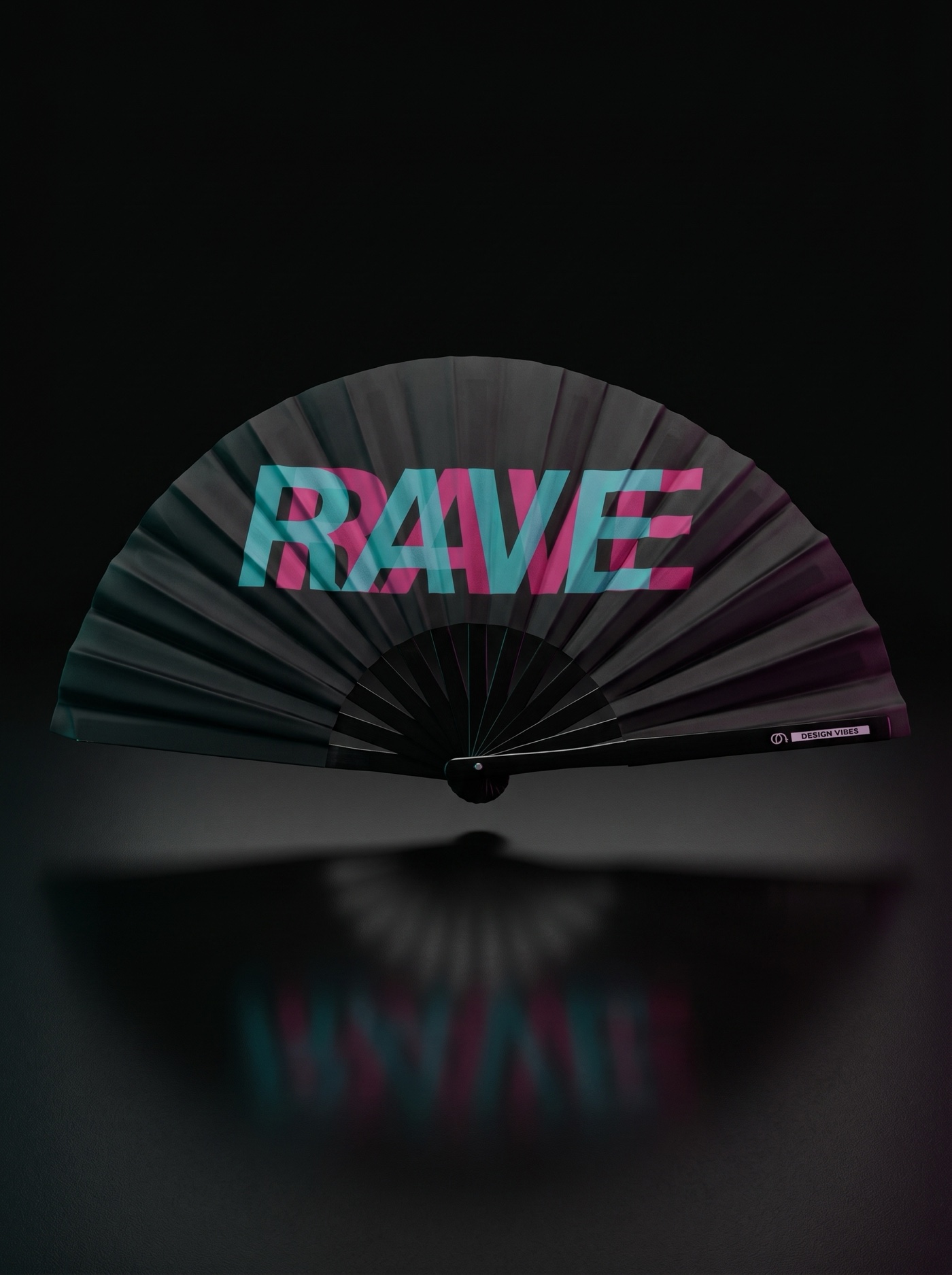
A design gets lost on a small pocket fan. But when unfolded to 64 cm, it comes to life: a holographic effect that changes color under the spotlight, a bold graphic, or a slogan—only on this surface can they be read from twenty meters away. If you’re unsure which design to choose, you’ll find the perfect fan for every vibe in our Festival Fan collection —ranging from holographic to glitter to statement designs. And if you want to browse what else we have to offer, it’s worth checking out the entire shop.
Space, Technology, the Right Size: How to Stay Truly Cool
Ultimately, a good fan comes down to a simple equation: enough surface area to move a lot of air with minimal effort, light enough to wave it with your wrist for hours on end, and the right technique so your arm can still keep up at four in the afternoon. A 64 cm span on a tear-resistant bamboo frame hits all these marks—impressive in appearance, light in the hand, and noticeably refreshing on the skin. When you’re planning your next festival, think about the surface area that will keep you cool and visible all day long, and put the fan at the very top of your packing list. The next hot Sunday in front of the main stage is sure to come, and when it does, you’ll want to be on the right side of physics.