That thing you pull out of your fanny pack at the festival has more history than most of the instruments on stage. The history of the hand fan stretches from Asian courts through the salons of the Baroque era to the Ballrooms of New York, and from there straight to the Front Row of festivals and parades. Those who know its history hold the fan differently: not as a gadget, but as an accessory with a history stretching back a few thousand years. Here’s the short version: compact, honest, and without passing off legends as facts.
The history of the hand fan begins in Asia
The earliest chapters of this story were written in Asia. Rigid fans made of feathers, leaves, or fabric-covered frames have been handed down from ancient China for millennia: as a sign of dignity, sun protection, and a status symbol at court. The folding fan, the form you know today, is considered a Japanese invention and spread from there throughout East Asia long before Europe even knew what it was missing.
Even back then, the saying held true: The material makes the fan. A bamboo frame, covered with fabric or silk, lightweight yet sturdy. So the fact that our fans today are made with bamboo frames isn’t just some eco-friendly fad, but the oldest material choice in the history of fans: it has simply never been proven wrong.
The fan was never merely a utilitarian object there. It appeared in dance and theater, in rituals and in art, serving as a canvas for painting and calligraphy. This dual role, both practical and expressive, has run through the entire history of the hand fan ever since: wherever it appears, it not only provides a cooling breeze, but also reveals something about the person holding it.
Via the trade routes to Europe
With the rise of long-distance trade in the early modern period, the folding fan made its way to Europe, where it immediately became what rare imports always become: a luxury item. Via the sea routes of the great trading powers, fans made their way to European courts; royal families vied for these exotic items, and soon specialized workshops sprang up to adopt and further develop the art of fan-making.
With that, the fan had finally become more than just a tool to beat the heat. It showed who could afford elegance: a status symbol that one carried casually in one’s hand, yet which everyone in the room noticed. A concept that’s probably familiar to you at any festival.
With the emergence of specialized workshops came specialization: fan-making became a craft in its own right, and both the production and trade of these coveted items sustained entire businesses. The fan became a fashion item in the best sense of the word, with changing shapes, sizes, and motifs depending on the decade and the court. It’s a rhythm you’ll recognize today: Even now, every season brings new designs, new colors, and new statements.
Baroque and Rococo: A Status Symbol with Its Own Legend
The fan reached its European peak during the Baroque and Rococo periods. Elaborately painted panels, frames made of precious materials, motifs ranging from mythology to the latest gossip: the fan was a must-have accessory for court ladies and a showcase for craftsmanship in the smallest of spaces. Anyone of any standing carried one, and how one held it, opened it, and lowered it was part of one’s social demeanor.
The famous “fan language” of the salons also originated in this era: secret codes that ladies supposedly used to flirt and send messages via their fans. Just how much of this was actual practice and how much was later marketing is a matter of debate: there is much to suggest that the elaborate catalogs of signals were more a product of 19th-century marketing ingenuity than genuine everyday salon life. Nevertheless, the legend remains charming as long as it is told as a legend.
It is interesting to note what the fan reveals about communication during this era. In a society governed by etiquette, it served as an outlet: one could hide behind it, look over it, and use it to direct attention, all without saying a single word. The fan was the permitted form of play within a strictly regulated space, and it is precisely this quality, expression within rules, that makes it special to this day.
The Decline in the 20th Century
Then the fan fell out of favor. Fashion became faster-paced and more practical; the handbag took on the role of a constant companion, and with the advent of electric fans and air conditioning, the issue of cooling seemed to have been technically resolved. The fan slipped into a niche: a vacation souvenir, a collector’s item behind glass, a prop in the theater.
But it never completely disappeared. In Spain, the fan remained a part of everyday life and flamenco; in parts of Asia, it remained part of tradition and craftsmanship. The flame kept burning while the rest of the world thought it had gone out.
In retrospect, this decline was less a defeat than a hiatus. Art forms disappear when their stage disappears: without court balls and salons, the fan simply had no place to be performed. What it needed was not new technology, but a new place where passion, people, and the need for expression could come together again. It took several decades to find that place. It has bass.
Flamenco, Ballroom, Rave: A New Chapter in the History of the Fan
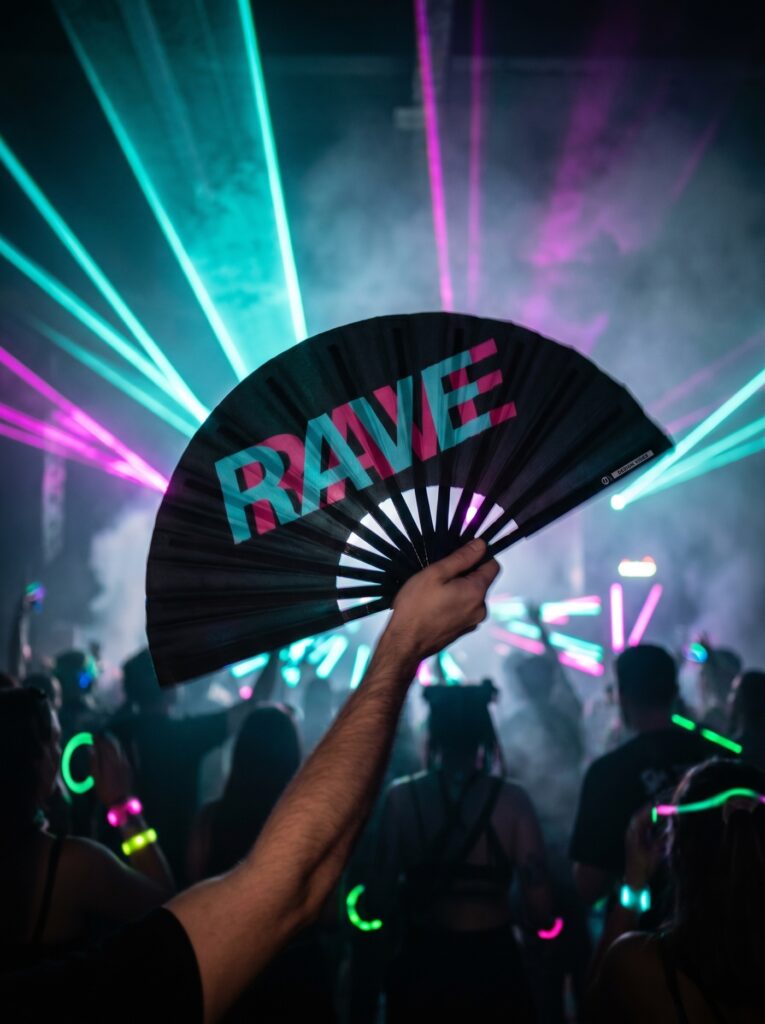
The fan owes its return to the big stage to subcultures. Flamenco kept the artistry and drama of the gesture alive. In the Ballroom scene, shaped by Black and Latino queer communities, the fan became a performance element: fanning out as an exclamation mark, the Clack as applause that cuts through the room. And Rave culture eventually discovered both uses for itself: a tool to combat the heat in clubs and an instrument for grand performances.
From there, it was a short step back into the public eye. Today, the fan is as much a part of the scene at parades and Pride events as it is in the crowd in front of the stage: The Pride collection and the Techno and Rave designs are direct descendants of these two movements, and they carry on their ethos: Visibility is not a coincidence, but a choice.
It’s no coincidence that dance floors, of all places, brought back the fan. Clubs and festivals provide exactly the conditions for which it was invented: too many bodies, too little air, and an audience that loves grand gestures. Add to that the night as a stage: under lasers and strobes, every fan movement becomes choreography, and fanning oneself becomes a performance that can be seen even from the back row.
Today: Statement and Tools
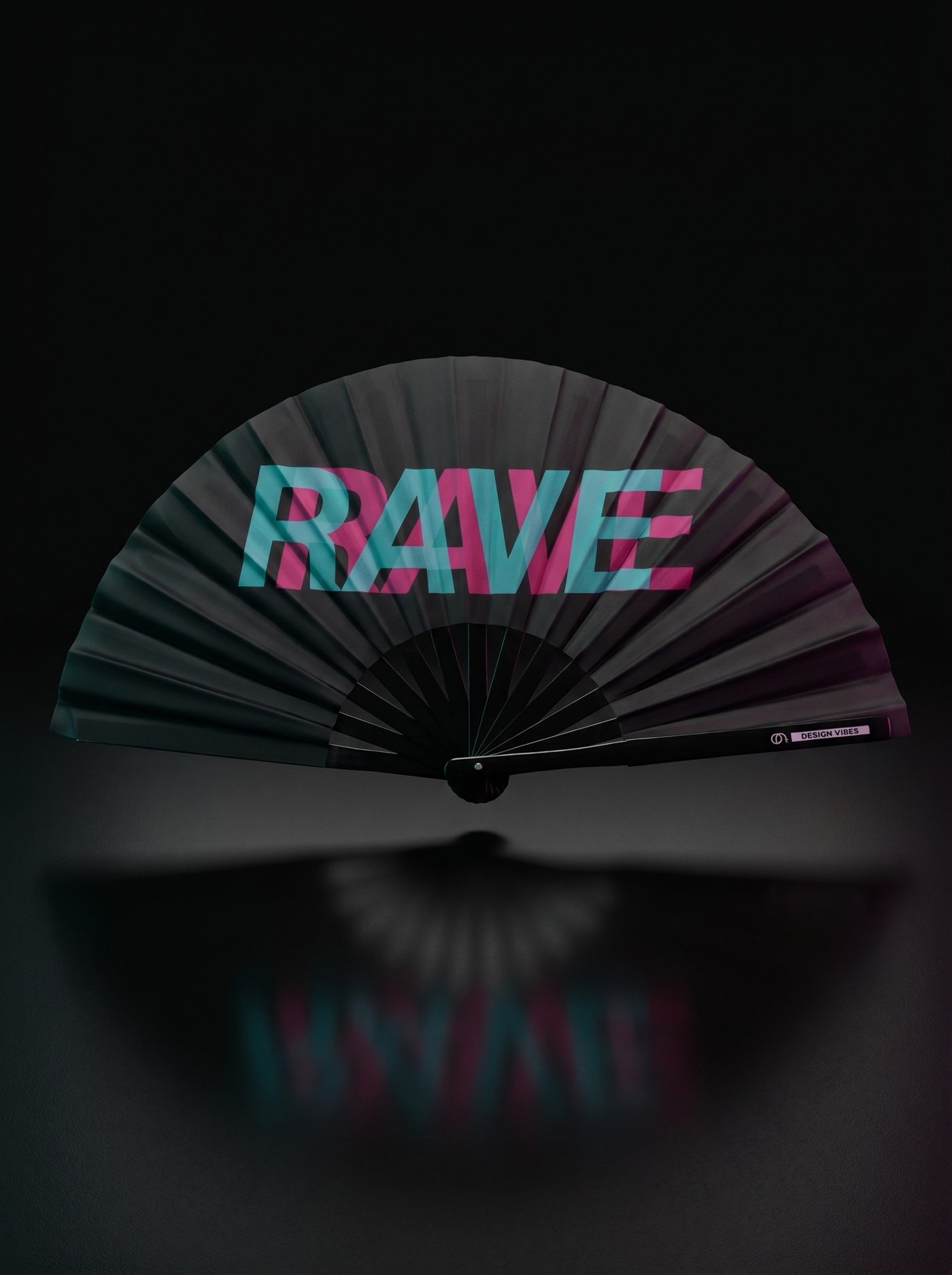
The modern Festival Fan embodies both traditions. From the historical fan comes the construction: a bamboo frame, a folding mechanism, and a large surface area. From subcultures comes the attitude: a 64-centimeter span serving as a stage for designs ranging from holographic to statement slogans, tear-resistant fabric instead of delicate silk, and a signature “Clack” that demands to be heard. The court lady would have loved the sound, she just would never have admitted it.
The occasions have also multiplied. The same fan that’s used in front of the festival stage in July shows up at the parade in August, at the club in October, and at the New Year’s Eve party in December. It has gone from being a seasonal accessory to a year-round companion, and with every new stage, it becomes more and more a matter of course: what stood out yesterday is now as much a part of the scene as a fanny pack and sunglasses.
What has remained, of all things, is the unspectacular: the craftsmanship. A fan only works when the frame, tension, and folding mechanism interact precisely; otherwise, there is neither a smooth swing nor a rich “Clack.” In this respect, every good fan upholds an age-old promise: it is technology without electricity, perfected over centuries and still relevant today.
A quick rundown of the whole story:
- Ancient China: Rigid Fans as a Sign of Dignity, Sun Protection, and a Status Symbol
- Japan: The folding fan is invented and takes East Asia by storm
- Early Modern Period: Trade routes brought the fan to Europe as a luxury item
- Baroque and Rococo: Their Heyday as Accessories of the Courts and Salons
- 20th Century: Fans and Air Conditioning Push the Fan into a Niche
- Flamenco and Ballroom: Subcultures Keep Traditions and Gestures Alive
- Rave, Festival, Pride: The fan makes a statement as it returns to the Front Row
“The fan was never just wind: it was always language. We just gave it a new dialect, and that dialect is called Clack.”
It took a few thousand years to end up in your hand at a festival: The history of the hand fan is the story of an object that always makes a comeback whenever people have something to say and start to break a sweat. You’ll write the next chapter yourself. You’ll find the tool you need in the shop: made in Hamburg, ready to ship in 24 hours. A lady-in-waiting is optional, but poise is a must. Find your next folding hand fan on our homepage, or see every design at once among our hand fans for festivals.