
There are two ways to open a fan. One looks like a motion you’ve done a thousand times: a flick of the wrist, a loud Clack, and you’re done. The other looks like a struggle with a stubborn umbrella. The difference isn’t a matter of years of practice, but of minutes, if you understand how the thing is built. This guide shows you how to open a hand fan, how to close it and how to care for it so it lasts not just through one festival, but the entire season. And yes: that crisp “Clack” is explained here, too.
Contents
Before you learn how to open a hand fan: understand how it works
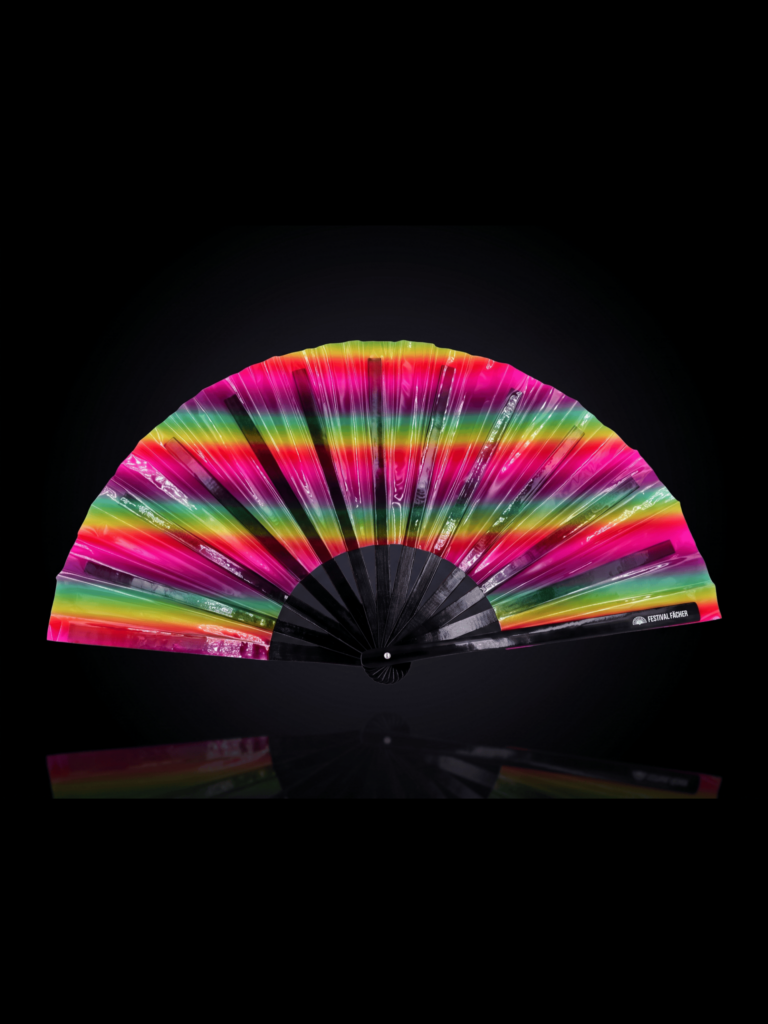
A folding fan consists of three parts, and if you know what they are, you’ll automatically be less likely to break it. First, the ribs: on a Festival Fan, they’re made of bamboo, lightweight and flexible, but like any natural material, they have their limits. The two outer ribs are thicker than the inner ones; they protect the folded fan like a book cover. Second, the fabric: the material that connects the ribs and spans the surface when the fan is opened, designed here to be tear-resistant, which forgives everyday mishaps but not acts of violence.
Third, the pivot point: the rivet at the bottom through which all the ribs pass. It is the mechanical heart of the fan. Every movement you make is transmitted to the pivot point, and almost every broken fan fails right there or at a single overstretched rib.
The most important lesson to be learned from the structure: A fan should be moved as a whole, not by individual ribs. If you pull on the paper or grip a middle rib, you’re working against the structure. If you guide the fan by the cover and let the rest follow, you’re working with it.
How to Open a Hand Fan: Step by Step
Here’s how to open a hand fan correctly
To start with, here’s the controlled version, it always works and doesn’t put any strain on anything:
- Hold the fan by its lower end, near the pivot point, with your thumb on the top rib.
- Point the tip of the fan slightly upward and away from you.
- Use your thumb to push up the top cover strip; the fan will begin to unfold.
- With a smooth, gentle twist of your wrist, let the remaining struts extend until the surface is fully stretched.
- It’s ready when the fabric is evenly taut; at full span, that’s 64 centimeters.
Important: The fan opens via the struts, never via the fabric. If it gets stuck, don’t pull on it, usually one of the struts is slightly askew. Close it completely for a moment, then try again. After a few cycles, the mechanism will run noticeably more smoothly as the struts and fabric adjust to each other.
How do you hold a hand fan properly?
Hold the fan at the bottom, close to the pivot, with your thumb on the outer guard stick. Your other fingers wrap loosely around the lower third. That way you open it through the sticks, not the fabric, and that is most of what there is to know about how to open a hand fan. To fan yourself, move your wrist rather than your whole arm: small, even movements are enough and spare the pivot. When it is closed, hold it by the lower third as well, so it is open again in a second.
The crisp Clack, with no risk of breakage
The “Clack”, that loud, sharp sound made when fanning with a single sweep, is the ultimate skill and the reason why fans are not only seen but also heard at festivals and Pride events. This is how to open a hand fan with one sweep without ruining it: Hold the closed fan loosely but firmly by the lower third. The motion comes from your wrist, not your arm, a short, decisive snapping motion to the side, as if you were flinging water off your fingers.
The fan unfolds on its own through the momentum of the swing; the sound is created when the ribs strike the fabric simultaneously at the end of the movement. A fan with a loud signature “Clack” is built exactly for this, you don’t need to apply any force; the design does the work.
The two most common mistakes: using too much force and stopping the motion at the elbow. Both of these channel all the energy into the pivot point. Remember: The “Clack” is about technique, not force. If it doesn’t click after the fifth try, the movement is too slow or too tense, relax, start with a smaller motion, and snap faster.
The Clack isn’t a matter of strength. It’s a wrist that knows what it’s doing.
Close & Store
To close it, follow the reverse order, but with the same calm: tilt the fans slightly, guide the top strut back with your free hand, and let the struts come together. Don’t squeeze them together like a book that won’t close; if you encounter resistance, it means a fold in the fabric is lying across the span, and that needs to be smoothed out, not flattened. When fully closed, the top struts lie flush against one another, protecting the fabric and the inner struts.
When stowing it away, always make sure it’s completely closed, never put it in your bag half-open. A half-open fan in a fanny pack acts as a lever just waiting to be stressed. It’s best to place it vertically in your bag with the fan closed, with the pivot point facing down, that way, any external pressure is absorbed by the sturdy support ribs. By the way, on your festival packing list, the fan belongs in your day pack, not in your tent: it’s no use to you where you aren’t.
Common Mistakes That Ruin Fans
Almost all fan damage can be traced back to a handful of recurring mistakes:
- Pull on the fabric rather than the struts; the fabric is tear-resistant, but it’s a flat surface, not something you can grip.
- If you use the open fan as a seat cushion, fly swatter, or pointer, the individual ribs will break first.
- Store it half-open, the classic method; see above.
- Clack, with a swing of the arm and all my strength, the pivot wobbles.
- Folding it while wet causes the damp fabric to stick together, creating creases that damage the material.
- Do not store in a hot car or in direct sunlight; heat dries out bamboo and makes it brittle.
- Stepping on or sitting on something amid the chaos in the tent, it sounds trivial, but it’s the number one cause of death on Sunday mornings.
Fan Care: Cleaning, Drying, and Storage
The good news about fan care: It takes two minutes and doesn’t require any special tools. After a dusty weekend, you’ll want to clean your hand fan before putting it away in a drawer. Here’s how to do it right: Open the fan fully, shake out any coarse dust, or wipe it down with a dry, soft cloth. For anything that’s stuck on, like drink spills, sunscreen, or glitter from someone else’s shoulders, a slightly damp cloth is all you need to gently wipe down the fabric. No soaking, no scrubbing, no harsh cleaners: “Damp” means damp, not wet.
Next comes the most important, and most commonly skipped, step: let it dry open. An open fan dries on its own in no time; one that’s folded up while still damp will develop mildew stains and stuck-together folds. So: lay it out open, let the air circulate, and only then close it. Direct heat from a heater or hair dryer is a no-no, it warps bamboo faster than you can blink.
For storage between festivals, follow these guidelines: keep them closed, dry, and either lying flat or standing upright without any external pressure. Don’t put them under a stack of books or in a crammed-full box. If you store your fan over the winter just like you would a good piece of clothing, you’ll unpack it in the spring to find it looking and clicking just like it did on the very first day.
When a fan’s season ends
Let’s be honest: Even the best-maintained fan is a practical item, not an heirloom. There are three signs that it’s time to say goodbye. First: a broken or significantly cracked rib, it transfers its load to the adjacent ribs, causing the damage to spread. Second: a worn-out hinge, causing the fan to sag rather than stand taut when open. Third: tears in the fabric along the folds.
Small imperfections, faded spots, character, none of that’s a problem; it’s just seasonal patina. But a fan that no longer snaps shut with a “Clack” but instead rattles has served its purpose. Then it’s time for a new design, and for the realization that the second season with the techniques from this guide will last significantly longer than the first.
That is how to open a hand fan: with a flick of the wrist. Close it gently, wipe it down with a damp cloth, and let it air dry: that’s all it takes to make your fan last the whole season. The rest is practice, and the best place to do that is right where the Clack belongs: in front of the stage. Find the right hand fan for your next festival day on our homepage.