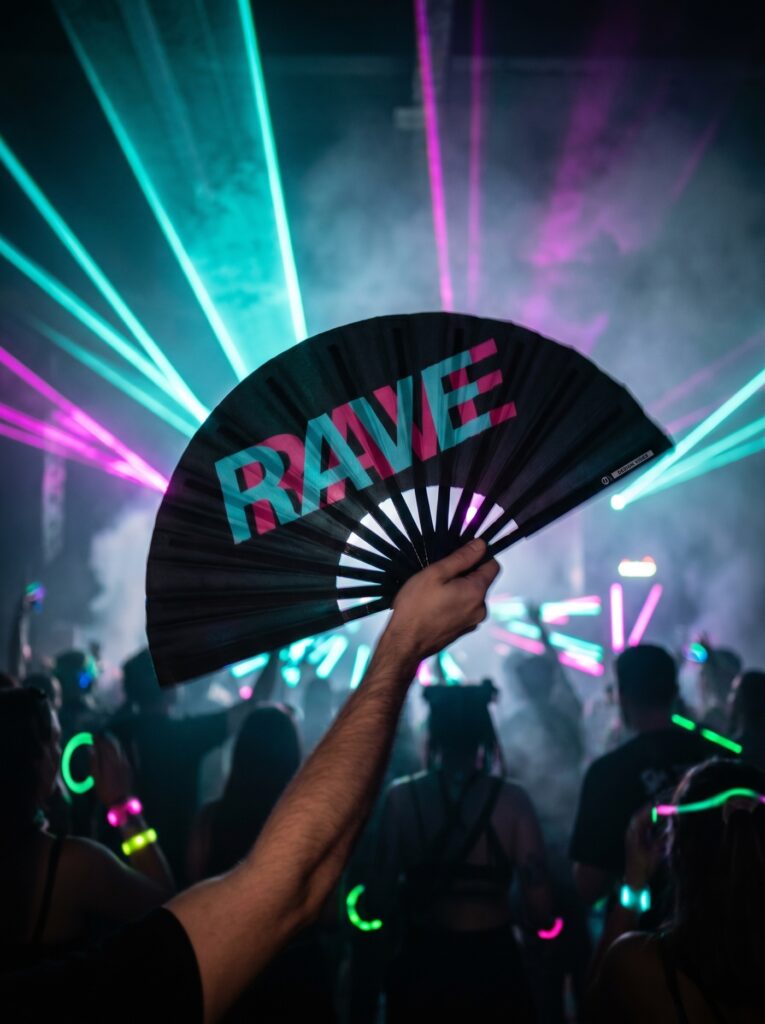

You’re back from the weekend, your head’s still beating to the bass drum, and your camera roll is full: 400 photos that all look pretty much the same. A crowd in the semi-darkness, a few blurry lights, the back of your head. This is exactly where the problem with most festival photos lies, they capture the moment, but not the feeling.
Contents
When looking for good festival content ideas, people usually think of expensive gear first. But the most useful prop has been right in your hand all along. A handheld fan with a 64 cm span brings three elements that instantly make every photo and every reel better: movement, surface area, and sound. And all without an extra battery, app, or tripod.
Why a fan is the best festival prop for your cell phone
A good reel thrives on movement. But most festival clips are static: You’re standing still, the stage is stationary, only the crowd is moving. A fan changes that in a second. It fills the frame, moves in a clear rhythm, and makes that signature “Clack” sound when it’s fanned open.
That very “Clack” is gold for short videos because it can be edited to transition right into the beat. You hear the fan opening, the image cuts, and the drop kicks in. That’s the difference between a clip you swipe past and one you watch twice.
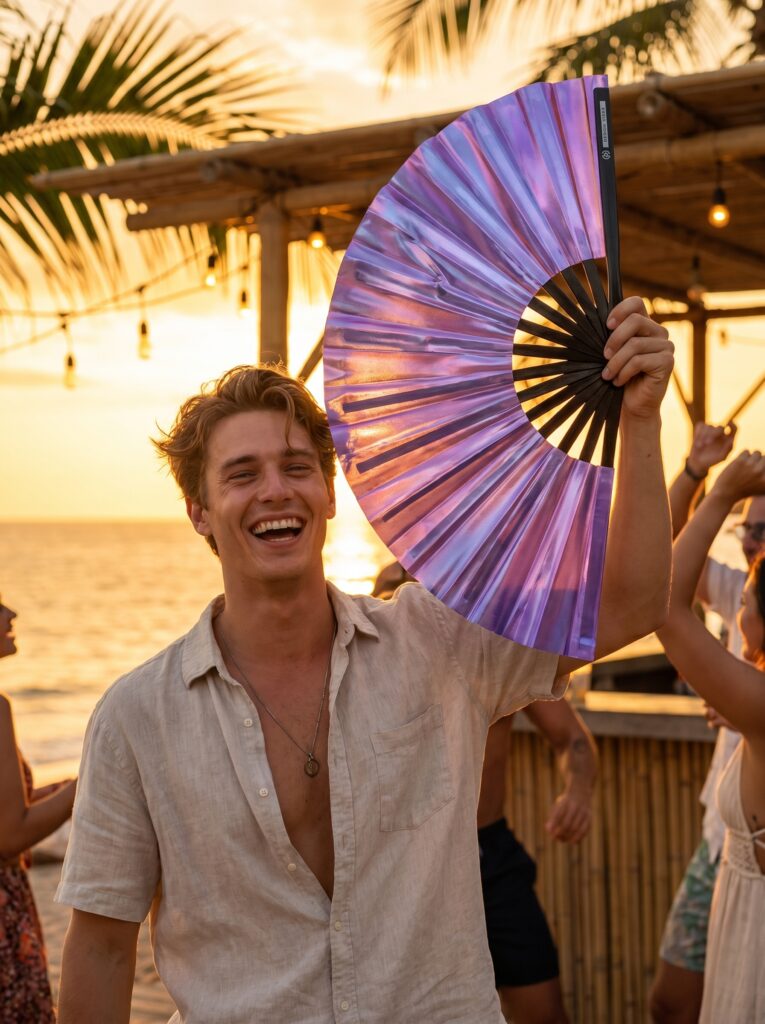
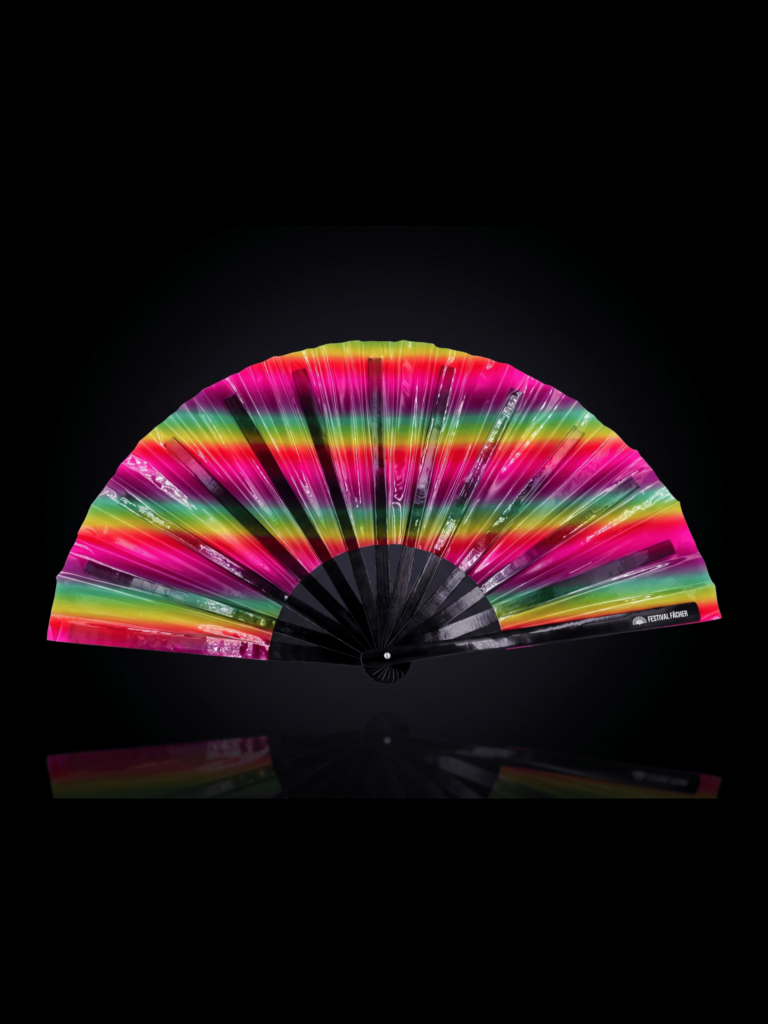
Then there’s the visual appeal. A large, fanned-out surface is instantly recognizable in a photo, even from a distance and in the dim light of a campsite. A holographic design refracts light and casts new colors with every movement, while a comic-style motif stands out even as a still image. If you want to know which designs are particularly well-suited for photography, check out the Holographic & Metallic Collection, because light-reactive surfaces are almost unbeatable in front of the camera.
8 Ideas for Festival Photos That Actually Work
You don’t need any directing experience, just a few ideas in your head before your battery runs out. These eight shots cover everything, from a quick reel to a photo you’ll want to frame. Don’t worry too much about the order, but try each one at least once.
- Clack transition to the beat: Film yourself with the fan closed, then open it exactly on the drop. The clack becomes an audible cut, and the transition happens naturally.
- Silhouette against the sunset: Stand with your back to the sun and hold the open fan sideways toward the light. The frame stands out, and the fabric glows from behind.
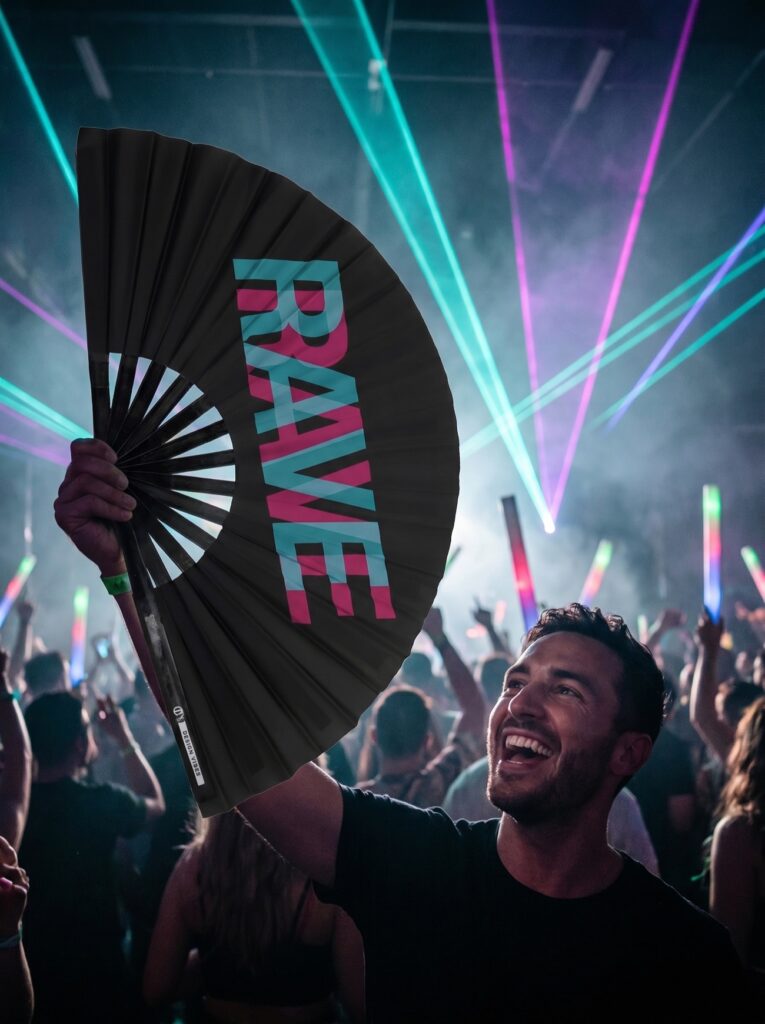
- Group Coordinated Fans: The whole crew fans in unison. When everyone wears the same design, it creates a pattern that immediately stands out in the feed. With the “Buy 5, Pay for 4” promotion, the crew is quickly outfitted.
- Close-up of the holographic effect: Get up close and move the fan slowly in front of the lens. The colors shift, creating a hypnotic loop that lasts a few seconds.
- POV from behind the fan: Hold the fan in front of the camera so that only your eyes are visible above it, then lower it. A classic reveal that never fails.
- Slow-Motion Fanning: Switch to slow motion and fan vigorously. Flying hair, fluttering fabric, everything becomes cinematic, even in mediocre lighting.
- Movement Loop in Time with the Beat: A short, repeatable clip where you open and close your fan in time with the beat. Perfect as a seamless loop for Stories.
- Statement to the camera: A slogan fan that you open at just the right moment conveys your attitude without a single word of text. You can find ideas for this in the slogan and statement designs.
The trick with all eight is this: Take more footage than you need. Three takes per idea, that way, you’ll have plenty to choose from when editing. A fan hardly tires you out, unlike an arm that has to hold a cell phone up for a long time.
Light Makes All the Difference: The Golden Hour vs. Strobe
Even the best prop can’t rescue festival photos in bad lighting, so it’s worth knowing the two lighting conditions of a festival day. During the day, the golden hour, the last hour before sunset, is your best friend. The light is soft, warm, and comes in flat from the side. That’s exactly when silhouettes and close-ups work best, because the sun shines through the fabric and makes colors glow. Position yourself so that the sun is behind or to the side of the fan, not directly in front of your face.
At night, you flip the logic on its head. Strobes, lasers, and shifting spotlights rule the dance floor. This light is harsh and flashing, that’s not a mistake, but your effect. A holographic or metallic fan catches every beam and reflects it back. When it comes to videos, it’s best to film a little longer, because under the strobe, every single frame is different. When editing, you’ll pick out the most impactful moments.
A dark design against bright stage lights creates stark contrasts, while a bright design against a dark crowd really stands out. Both work, you just need to know which look you want.
Quick Editing Tips for Reels That People Watch All the Way Through
Recording is half the battle; editing does the rest. You don’t need professional software, the built-in features of your phone app are more than enough. The key is to work with the natural rhythm of your footage instead of editing against it.
- Cut to the beat: Place your cuts where something is happening in the track. Using the “Clack” as a transition is the easiest way to sync the video and audio.
- The first second is crucial: The most powerful moment should come at the beginning, not the end. An opening scene featuring a fan unfolding keeps viewers engaged in the video.
- Fewer clips, longer moments: Three well-composed shots are better than twelve frantic ones. Give each shot a moment to sink in.
- Shoot in portrait orientation from the start: Just shoot vertically, and then you won’t have to crop anything and won’t lose any resolution.
- Keep the sound: The original sound with the “Clack” is often better than any added track. Try both versions.
One detail that many people underestimate: Content isn’t just created in the frenzy of the night. The quiet moments at the campsite, fanning yourself in the tent in the morning to beat the rising heat, getting dressed before the first set, all of that tells your festival story just as much as the drop. If you document your weekend from the very beginning, you’ll end up with a cohesive narrative rather than just a collection of festival photos. Check out the 2026 Festival Packing List to see how to pack the rest of your gear.
Respect for the Lens: Content with Attitude
A festival is a shared space, and your content ends where other people’s privacy begins. Don’t film strangers up close without asking first, especially not during moments that are clearly recognizable. For group shots, remember: Your crew participates because they want to, not just because the camera is already rolling. And keep in mind that you’re standing in a crowd. A fan held open in front of the camera makes a statement; a cell phone that’s constantly hovering above everyone’s heads blocks the view for the people behind you. The best content comes when you’re fully present in the moment anyway, not when you’re watching the whole scene through a screen.
A good festival video doesn’t just show that you were there. It shows how it felt.
That’s exactly what a prop can do, it combines movement, surface, and sound. The fan isn’t the star of the show; it’s the amplifier for your own moment. It gives your hands something to do, adds movement to your image, and sets the rhythm for your reel.
The Right Design for Better Festival Photos
Ultimately, the look stands or falls on the design in your hands. Holographic and metallic for anything meant to play with light. Comic-style and bold graphics for daytime festivals, because they work even in still festival photos. A slogan if your content is meant to make a clear statement. For the whole crew in a group shot, a unified motif is worth it so the image creates a pattern instead of chaos.
If you’re unsure where to start, check out our selection of Festival Fans to get an overview of the different design styles. The next festival is sure to come, and this time you’ll bring back not just memories, but content that really looks like it came from a festival. Ready to pick yours? Our homepage is the place to start for your next hand fan.