You hear it before you see it: a sharp, loud Clack somewhere in the crowd, and everyone knows what it means. The fan clack is perhaps the shortest statement in the festival world: applause, an exclamation mark, and an announcement all in a single hand gesture. But like any language, the language of the fan clack has its own grammar. There are moments when the Clack says it all, and moments when it’s simply out of place. Time for a little etiquette lesson: from Ballroom culture, to which we owe the Clack as a form of applause, to the question of what your fan is actually saying when you’re not saying anything at all.
The “Fan Clack” and Its Meaning: Applause from Ballroom Culture
To understand what the “Clack” means, you have to look to the Ballroom scene: the culture of balls and houses, shaped by Black and Latino queer communities, where performance, category, and audience form their own ecosystem. There, the fan has long been part of the performance, and the loud snapping is one of the ways the audience shows enthusiasm: an applause that cuts through the room, more precise and personal than clapping.
From there, the gesture spread along with Ballroom culture to clubs, parades, and festivals. So when you Clack to the drop today, you’re paying homage to a community that turned this tool into a form of expression: reason enough to use the gesture with respect and to be aware of its origins, rather than thinking of it as something invented during the last festival season.
The Approval Levels: From a Single Clack to Continuous Fire
Like any applause, the Clack has different nuances, and the crowd understands them intuitively:
- A single Clack: an exclamation mark. Short, crisp, precise, for a seamless transition or a moment that deserves recognition.
- The Clack Series: genuine excitement. Three or four clicks in a row tell you: This is something special.
- Continuous fire: the escalation level. When multiple fans rattle at the same time, the crowd celebrates as one: the fan equivalent of a roar of cheers.
The trick is in moderation. If you’re constantly Clacking, you’ll end up saying nothing at all: an exclamation point only makes an impact if it’s not at the end of every sentence. Treat your Clacks like your voice. You don’t yell all the time, but only when it really matters.
When to Use the Clack: Drop, Performance, Demo
The Clack is at home wherever energy is celebrated. At the drop, when the track finally kicks in after minutes of build-up: that’s its natural habitat. During a performance, whether it’s Voguing at a ball, a dancer on stage, or a spontaneous move in the crowd, the Clack says “seen and celebrated” without you having to shout through the crowd.
And at a demonstration, at Pride, when a speech really hits the mark: the “Clack” is an audible expression of approval that carries farther than clapping, and makes a statement at the same time. A sea of fans snapping open in unison after a powerful line is solidarity in action, complete with a sound effect.
When to Hold It Back
Just as important are the moments when the fan remains closed. Quiet, atmospheric sets thrive on their intensity: a Clack at pianissimo isn’t a statement, it’s a distraction. The same goes for announcements and public address messages. When someone says something important into the microphone, whether it’s a safety announcement or a presentation, the space belongs to the voice, not the bamboo.
At protests, there are also moments of remembrance and silence: during those times, keep your fan closed, no discussion. And the basic rule applies everywhere: never clack it right next to someone else’s ear. The thing is loud, that’s its job. Staying half a meter away and taking a quick look to see who’s standing next to you, that’s the whole secret to considerate volume.
Fan Language Today: What Your Gestures Reveal
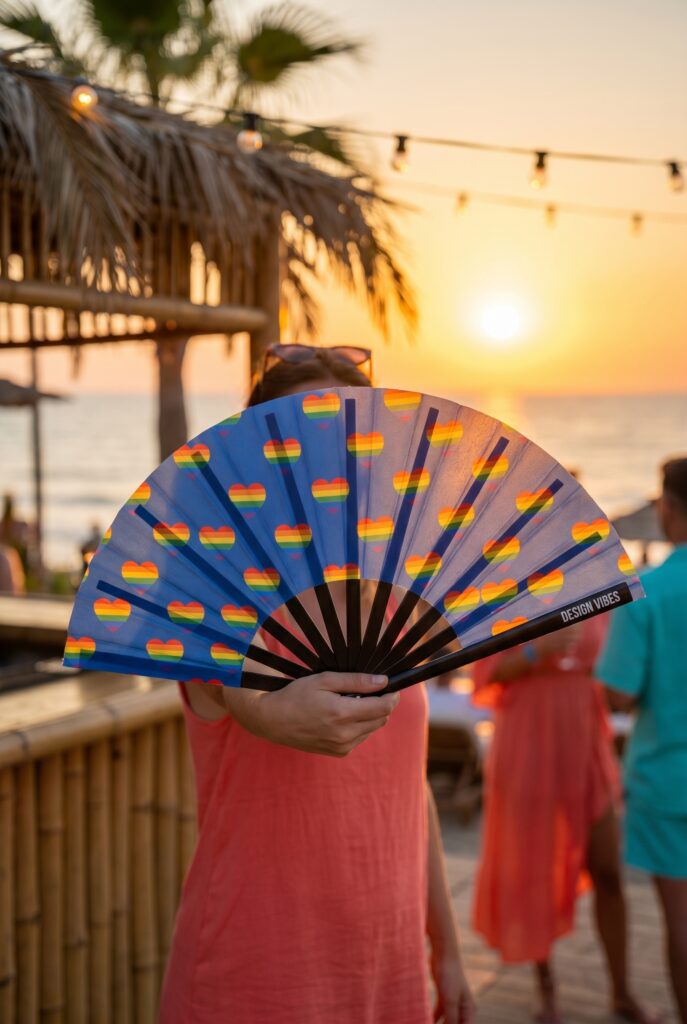
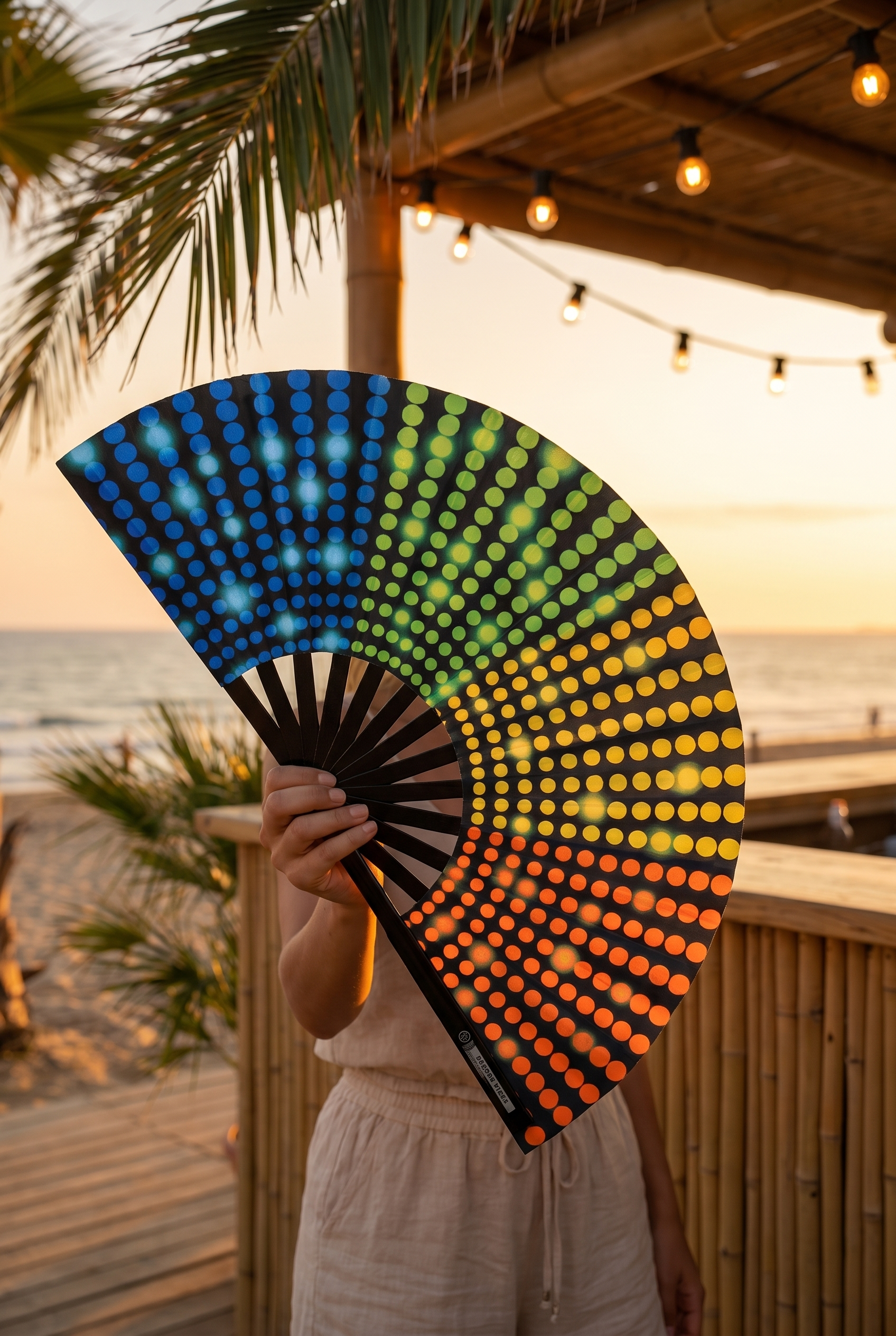
Besides the Clack, the fan also speaks softly. The slow opening is a show in itself: it signals that something is about to happen. Waving it toward a friend is an act of care, a shared breeze serving as a small declaration of love amid the hustle and bustle. Glancing over the edge of the fan is the oldest flirting move in the world, and it works just as well in a club as it once did in a salon. And covering your face is pure drama: mystery, a pose, a photo op.
None of this is a fixed code, and that is precisely the strength of this fan language: Everyone understands these gestures without a dictionary. Winking is expressly allowed. Those who move their fans with the right timing can carry on a conversation that would require others to use a megaphone, and a “statement fan” even speaks its message verbatim.
The Myth of Historical Fan Language
And what about the famous fan language of the salons, the secret codes with which ladies supposedly conducted entire conversations? The honest answer: it is, above all, a beautiful legend. The elaborate catalogs of signals, which are still cited today, likely stem less from actual salon practice than from clever 19th-century marketing. Wonderful as an anecdote, but to be taken with a grain of salt as historical fact.
The good news: The fan language spoken today is real. It doesn’t need secret codes; instead, it has a vocabulary of Clacks, gestures, and design that every crowd understands immediately. It isn’t whispered in salons, but spoken on dance floors and at demos, loud enough to be heard over the bass.
“The Clack is applause you can feel: an exclamation mark made of bamboo, and you decide when the sentence ends.”
Clack Etiquette in a Nutshell
- Clack at the drop, during the performance, and after a powerful speech: that’s where it belongs.
- Use it sparingly: One deliberate Clack is worth ten casual ones.
- Keep your distance from people’s ears and faces in the crowd.
- The fan remains closed during quiet sets, announcements, and moments of silence.
- Know the origins: The “Clack” as a form of applause comes from Ballroom culture.
- And fanning is always fine: the wind doesn’t need any etiquette.
The language of the fan is not a science: it’s about timing, respect, and a little bit of showmanship. Anyone who uses the “Clack” deliberately, knows how to hold the quiet moments, and understands the origin of the gesture speaks it fluently. All that’s missing is the instrument: In the Pride collection and the rest of our lineup, you’ll find fans with bamboo frames, tear-resistant fabric, and the signature “Clack”, ready to ship from Hamburg within 24 hours. The rest is all about your wrist. Looking for more? Our large hand fans are waiting, and the homepage shows you what makes a good festival hand fan.