
When a hand fan opens with a loud “Clack” at a festival today, there’s more history behind it than most people realize. Voguing and the ballroom scene have carved out a place for the hand fan on today’s stage: as a performance element, as a form of applause, and as a statement. Anyone who celebrates the fan should know where this energy comes from. This article respectfully recounts the story, from the Ballrooms in Harlem to the Front Row at Pride.
What Voguing Is and Where It Comes From
Voguing is a dance style that originated in the Ballroom scene, shaped by Black and Latino queer communities in Harlem, New York. At a time when these people were excluded from large parts of society, they created their own spaces: the balls. There, people danced, posed, walked, and celebrated, across categories ranging from “realness” to “performance.” Voguing was never just about dance. It was self-assertion, an art form, and a community all in one.
The name alludes to the fashion magazine *Vogue*: The poses are reminiscent of those struck by models on glossy pages, strung together in time with the beat. Static poses gave way to movement; movement evolved into a vocabulary with its own rules, lines, and attitudes. Anyone who has ever seen a performer trace a diagonal line across the floor understands immediately: this is about precision and presence, not chance.
Broadly speaking, the scene distinguishes between several styles that have developed over the decades:
- Old Way: the early form, characterized by clean lines, symmetry, and precise poses.
- New Way: a later evolution featuring greater flexibility, contortions, and geometric shapes.
- Vogue Fem: a distinctly feminine style, dramatic, fluid, and expressive, featuring elements such as duckwalks, spins, and dips.
This list is intentionally kept general. Ballroom is a vibrant culture with its own authorities, and the nuances of the categories belong to those who dance and judge them. If you want to dive deeper, watch balls, listen to the commentators, and learn from the community itself.
Houses and Balls: Family is whoever is there for you
At the heart of the Ballroom scene are the Houses. A House is more than just a team: it’s a chosen family led by a Mother or a Father who support, train, and care for their Kids. For many young queer people who have been rejected by their biological families, Houses have been, and continue to be, a home in the literal sense. At the balls, the Houses compete against one another in categories ranging from dance to runway to fashion.
A ball is both a competition and a celebration. There’s a jury, there are trophies, there are scores from the judges, and relentless chants from the audience. Above all, however, there’s a space where people are allowed to shine exactly as they are. This blend of intensity and warmth is what makes it so fascinating: on the dance floor, people fight for everything, but off the floor, they look out for one another.
The Fan in Voguing: Props, Rhythm, Applause
And this is where the fan comes into play. In Ballroom culture, the hand fan is a performance element with a dual function. On the one hand, it’s a prop: a fan extends the line of the arm, emphasizes poses, conceals and reveals the face, and adds accents in time with the beat. On the other hand, it’s an instrument: the loud clap, the “Clack”, is a form of applause and approval in the scene. When a performance is on point, the fans in the audience clack away. The harder the move, the louder the response.
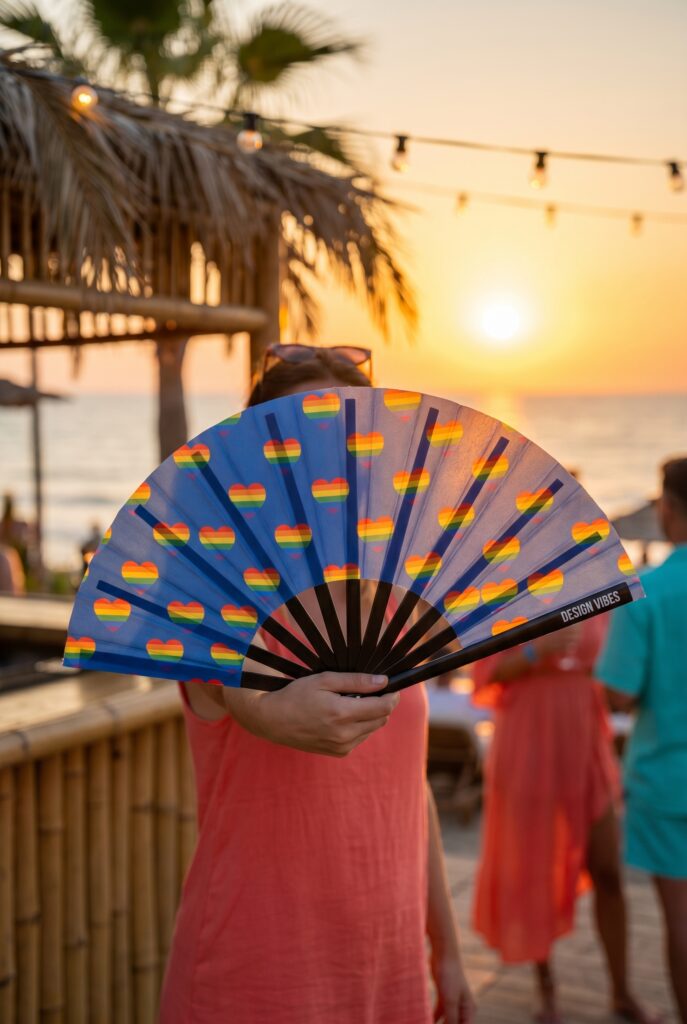
That “Clack” is why a good fan must be sturdily built. A fan from the Pride Collection, with a bamboo frame and tear-resistant fabric, can withstand exactly that: hundreds of “Clacks” per night without the ribs giving way. The sound is produced when the ribs strike against each other during a sudden, jerky opening of the fan. Cheap designs sound muffled or break. A crisp Clack is loud, dry, and distinct.
The Clack isn’t a sound. It’s a response: I see you, and what you just did was amazing.
From the Ballroom to the Mainstream
The fact that Voguing is known worldwide today is due to a few key moments. Madonna brought the style into the charts and onto the big stages in the early ’90s with her song “Vogue.” The documentary “Paris Is Burning” showcased New York’s Ballroom scene and introduced terms like “houses,” “realness,” and “shade” to a wide audience. Decades later, the series “Pose” retold the stories of the scene for a new generation, featuring queer people both in front of and behind the camera.
With each of these waves, elements of the culture made their way further into pop culture, the club scene, and the festival world: the moves, the language, the attitude, and, of course, the fan. Today, it’s just as much a part of the scene on Techno dance floors as it is at Pride parades. What’s easily forgotten is that none of this is simply a “trend.” It’s the legacy of a community that has fought for its visibility in the face of enormous resistance.
At the same time, a second path led into the present: club culture. House music and Ballroom have always been closely linked; many tracks played at balls were also played on dance floors in major cities. When Techno and house arrived in Europe, their aesthetics and gestures came along with them. Today, the circle is complete: at festivals from Berlin to Amsterdam, fans, poses, and the “Clack” are part of the crowd’s vocabulary, often without those using them even knowing where that vocabulary comes from. That’s exactly why articles like this one exist.
Respect for Our Roots: Celebrate, Yes; Appropriate, No
Do you have to be part of the Ballroom scene to carry a fan? No. But it’s considered good form to know and acknowledge its origins. The difference between appreciation and co-optation lies in one’s attitude: Those who open their fans knowing that the “Clack” comes from Harlem’s Ballrooms are celebrating the culture. Those who pretend it’s all an invention of the festival season are erasing history.
Specifically, this means: Give credit when you talk about Voguing. Don’t treat moves and terms as mere costumes. If you’re a guest at a ball, you’re a guest, and you should act like one. And when queer people explain what a term means or where a boundary lies, listening is the right response. That’s not a high bar to clear. It’s the bare minimum of respect for the people who created this culture and continue to uphold it to this day.
A good place to start is at local Ballroom events, which are now held in many German cities. Many balls are open to the public, and there’s no better place to learn the codes quickly: when to “clack,” how a category works, and what the “tens” mean. Anyone who has ever experienced firsthand how an entire hall responds collectively with fans understands the difference between an accessory and a language.
Voguing Energy Today: From the Ball to Pride and the Festival Floor
At Pride, the fan has become something of an unofficial parade accessory: it cools you off when it’s thirty degrees on the asphalt, it serves as a canvas for colors and messages, and it responds to every great performance with a “Clack.” The signal has also caught on at festivals. When the beat drops, the fan opens up; during set changes, it wafts a cool breeze; and when someone in the crowd does something amazing, it clicks from all sides.
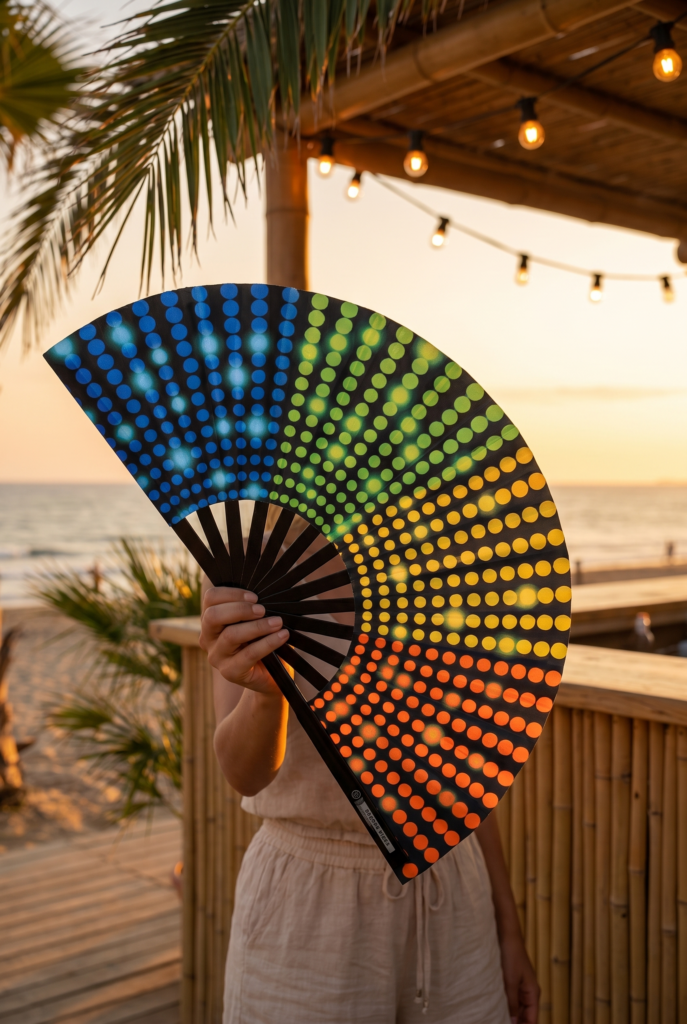
Anyone who wants to channel this energy will find designs in the shop for every stage: rainbows and bold statements for protests, holographic designs that change color under the spotlight, and loud slogans for everyone who has something to say. With a 64 cm span, each one is large enough to serve as a statement, not just an accessory.
The fan is on loan. Treat it with care.
Voguing and Ballroom have given the fan a meaning that goes far beyond simply cooling off: it embodies applause, poise, and stage presence all in one object. The next time you open your fan, you’ll be doing so as part of a tradition that began in Harlem and lives on today on every dance floor. Know the history, give it credit, and let the Clack make the sound it’s meant to make: loud, unmistakable, and full of respect. After all, “Front Row” isn’t just a seat number, it’s an attitude. Find your next folding hand fan on our homepage, or see every design at once among our hand fans for festivals.